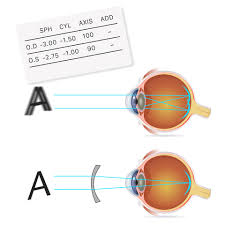
You walk out of your eye doctor's office feeling good. Your check-up is done, your eyes are healthy, and you've got your prescription card in hand. Then you look down at it and suddenly it feels like you're reading a secret code. SPH (SPHERICAL), CYL (CYLINDER), AXIS (DEGREE OF CYLINDER), OD Oculus Dexter (RIGHT EYE) OS Oculus Sinister (LEFT EYE) what does any of this even mean?
Most people sort of understand the SPH part. That's your basic power, how strong your lenses need to be. But CYL and AXIS? Those two always seem to trip people up. And honestly, that makes sense. Nobody explains them clearly.
So let's fix that today. By the time you finish reading this, you'll know exactly what CYL and AXIS mean, why they matter, and how they affect everything from the branded eyeglass frames you pick to whether your polarized sunglasses will actually work for you.
What Is 'Cylinder' and Why Does It Sound So Technical?
The short answer: Cylinder (written as CYL on your card) measures astigmatism. That's it.
But here's what astigmatism actually means, because most people have heard the word without really understanding it. Your eyeball is supposed to be shaped like a perfect sphere, think of a basketball. But in many people, the eye is slightly more oval or curved unevenly more like a football. That imperfect shape is what causes astigmatism, and it leads to blurry or distorted vision, sometimes at all distances.
The CYL number on your prescription tells the lens maker how much correction is needed to fix that blur. A small number like -0.50 or -0.75 means you have mild astigmatism. A higher number like -2.00 or -2.50 or more , means you need more significant correction. If your CYL box is blank or shows 0.00, great news you don't have astigmatism at all, and that part of the prescription simply doesn't apply to you.
One thing worth knowing: the CYL number is usually written as a negative in most prescriptions, but some eye doctors write it as a positive number. Both formats are valid. Your optician is trained to read either version, so don't let that confuse you.
So What Does 'Axis' Mean, Then?
Okay, so now you know that CYL tells you how much correction you need for astigmatism. But here's the thing: astigmatism doesn't just happen in one fixed direction. Because your eye has a specific shape and orientation, the blur you experience has a specific angle too. That's where AXIS comes in.
Think of it this way. If someone asked you to draw a line across a clock, there are 180 different angles you could draw it perfectly horizontal at 180 degrees, perfectly vertical at 90 degrees, or anything in between. Your AXIS number works the same way. It's a number between 1 and 180 that tells the lens maker exactly which direction to apply your astigmatism correction.
An AXIS of 90 means the correction runs up and down. An AXIS of 180 means it runs side to side. Every other number falls somewhere on that spectrum. There's no good or bad AXIS number; it's completely unique to your eye, just like a fingerprint.
And this is really important: CYL and AXIS always work together. If your CYL is blank, your AXIS will be blank too, because there's nothing to orient. You can't have one without the other. They're a package deal.
Why Does Getting This Right Actually Matter?
Here's where things get very practical especially in 2026, when so many people are buying eyewear online or upgrading to prescription sunglasses.
If even one number in your CYL or AXIS is entered incorrectly when ordering glasses, your lenses will be wrong. Not just slightly off actually wrong in a way that can cause headaches, eye strain, and sometimes even dizziness. Your brain is remarkably good at trying to compensate for bad lenses, but it uses up a lot of energy doing so. The result is that tired, strained feeling at the end of a screen-heavy day.
This matters especially when you're ordering branded eyeglass frames online. It's so easy to type in your SPH and forget the rest, or mix up your OD (right eye) and OS (left eye) values. Always double-check everything before hitting that order button.
And if you're shopping for power sunglasses which are prescription sunglasses that correct your vision and protect your eyes at the same time your full prescription including CYL and AXIS is absolutely essential. UV protection sunglasses that don't have your correct prescription are really just stylish accessories, not vision tools. They'll shield your eyes from the sun, sure, but they won't give you clear sight.
The same goes for polarized sunglasses. People love polarized lenses because they cut glare on water, roads, and snow. But if you have astigmatism and your polarized sunglasses aren't made with your full prescription, you'll still be squinting and straining behind those lenses. It defeats a big part of the purpose.
A Quick Word on Teen Eyewear in 2026
Teen eyewear has genuinely exploded as a category recently, and it's not hard to see why. Today's teenagers are incredibly aware of how glasses look. They've grown up watching influencers rock oversized frames, tinted lenses, and bold retro styles. Glasses aren't just a vision tool anymore. For a lot of teens, they're a fashion statement.
But here's the thing about teens and astigmatism: young eyes are still developing, which means CYL and AXIS values can shift from year to year. A teenager who had a mild -0.50 CYL last year might have got increase or decrease this year it all depend on your diet and physical fitness if you are taking good diet and doing physical activity then it can be got decrease, or if you are not taking good diet and less physical activity then it can increase or be same
. Wearing lenses based on an outdated prescription doesn't just affect their vision, it can affect their focus in school, their performance in sports, and even their posture (because people instinctively tilt their heads to compensate for blurry vision).
If you're a parent buying branded eyeglasses frames or prescription sunglasses for a teenager, please make sure the prescription is currently ideally checked within the last twelve months. And if your teen is into outdoor activities, look into UV protection sunglasses or polarized options with their correct prescription built in. It's a genuinely useful upgrade, not just a luxury.
How to Read a Full Prescription
Here’s a typical prescription layout so you can picture it:
OD (Right Eye): SPH -2.00 | CYL -1.25 | AXIS 90
OS (Left Eye): SPH -1.50 | CYL -0.75 | AXIS 180
In this example, both eyes have astigmatism but at different strengths and angles. The right eye needs more correction (-1.25) oriented vertically (AXIS 90), while the left eye needs less correction (-0.75) oriented horizontally (AXIS 180).
The spherical power (SPH) shows your basic vision correction. Both eyes are nearsighted here (negative values), with the right eye (-2.00) needing slightly stronger correction than the left (-1.50).
This is completely normal, most people’s two eyes are different from each other.
To Wrap It Up
Your prescription card has a lot going on, but CYL and AXIS don't have to be a mystery anymore. CYL tells you how much astigmatism correction your lenses need. AXIS tells them which direction to apply it. SPH (Spherical Power) tells whether you need help seeing near or far basically correcting nearsightedness or farsightedness. Together, they make sure the world looks sharp and clear instead of blurry and distorted.
Whether you're picking up a new pair of branded eyeglasses frames, treating yourself to prescription polarized sunglasses, investing in UV protection sunglasses for the outdoors, or helping a teenager find their next great pair of power sunglasses knowing your full prescription gives you the confidence to shop smart and see clearly.
Your eyes work hard for you every single day. Understanding what's on your prescription card is one of the simplest, most effective ways to take better care of them.
See clearly. Choose wisely.
FAQs
Q1. What if my CYL box is blank does that mean my eyes are perfect?
A: Not exactly. It just means you don't have astigmatism. Your eyes might still need correction for nearsightedness or farsightedness, which is shown in the SPH column. A blank CYL is actually simple good news: your cornea is evenly shaped, and your lenses don't need astigmatism correction.
Q2. Can I wear polarized sunglasses if I have astigmatism?
A: Yes, completely. You can order polarized sunglasses with your full prescription CYL, AXIS, and all built right into the lenses. Loads of optical stores and online eyewear brands offer this now. Just make sure you're sharing your full, updated prescription when you place the order. UV protection sunglasses are available in prescription formats too, so you don't have to choose between eye protection and clear vision.
Q3. My AXIS changed from last year. Should I be worried?
A: No, this is quite common especially for younger people and anyone in their twenties. Eyes shift and change over time. It doesn't mean something is wrong; it just means you need updated lenses. Always use your most recent prescription when buying branded eyeglass frames or power sunglasses. Using an old prescription is one of the most common reasons people get glasses that give them headaches.
Q4. Is teen eyewear different from adult eyewear in terms of how CYL and AXIS work?
A: The prescription format is exactly the same. What's different is that teens' eyes tend to change faster, so the numbers on their prescription card may shift more noticeably year to year. Regular check-ups every twelve months are especially important for teenagers. The good news is that many teen eyewear brands now design frames specifically for active, growing wearers — durable, comfortable, and genuinely stylish.
Q5. Can a wrong AXIS actually cause headaches?
A: Absolutely. Even a small error in your AXIS, say, 10 or 15 degrees off can cause your brain to work overtime trying to correct what your lenses aren't fixing properly. The result is real physical discomfort: headaches, eye fatigue, sometimes even mild nausea. This is why it's so important to enter every value correctly when ordering glasses online, and to always double-check that your OD and OS values haven't been swapped.